I crossed the Memorial Bridge on July 3rd, 2021 with a small U-Haul trailer and an unrivaled excitement. I was trading an old life for one that was unknown. I was more comfortable sitting with tribal sheikhs in newly liberated areas of the Middle East than donning a suit and tie every day to debate policy. Transitioning from the military after a decade of active-duty service wasn’t a new job — it was a metamorphosis. My first full day in Washington, D.C. was spent unpacking by day and watching fireworks on the National Mall that night. I felt the concussion of fireworks against my chest, replicating bombs bursting in air. I knew I had made the right decision.
Leaving the military was the hardest thing I have ever done. I was fortunate to have completed a fellowship at the Honor Foundation months prior to my separation from the military. I was in the late stages of interviewing with Angel, the hiring manager of a Fortune 50 tech company that was standing up a national security team. A while ago, a speaker named Mike had addressed my Honor Foundation cohort and offered mentorship to anyone who was interested in a career in Congress. I sent him an email before he was done speaking saying I wanted in. I asked Angel if the position I was interviewing for would still be there after a 3-month internship on the Hill.
She replied, “No, but you should take the internship. I did 3 years on the Senate Armed Services Committee, and it changed my life. If you do the internship, it’s a dealbreaker for this position, but call me when you’re done.”
That’s all it took (and I never called her back – except to thank her years later for [inadvertently] pushing me to Capitol Hill).
The internship didn’t work out, but it led me to TechCongress. Travis Moore, Founder and CEO of TechCongress, called and told me I had been chosen as a candidate. I told (asked — actually, convinced) my wife that this was an investment in our future and we would take the year to figure out if Washington, D.C. was somewhere we wanted to live and raise our children. She capitulated. I told myself I had one year to make this thing work. We rented a house in Shirlington and made arrangements to move. Our two sons were 1 and 3 years old at the time.
Summers in Washington were worse than the backwoods of Fort Bragg, North Carolina. During the placement process I had to arrive 30 minutes early to dry out my sweat-soaked suits – an occupational hazard of working on Capitol Hill. I was 35 years old and had no idea what I was doing, about to report to some 26 year old, fresh-out-of-law school staffer (this shouldn’t scare anyone, unless you’re a jaded, former enlisted member of the armed services…). I’ll admit, finding an office to work in was challenging, but I leaned on my advisors and the amazing networks of TechCongress alumni and veterans to help me. Congressman Darrell Issa’s office showed interest in me and made me an offer. It turns out, there’s a fit for any TechCongress Fellow — you just have to look. I had pitched myself as someone who wanted to reform the patent office with blockchain technology, amend Section 230 (which made the internet what it is today, and is much harder to reform than I initially thought), and offer my practical experience to his leadership on the House Foreign Affairs Committee.
My first day in the office was August 15th, 2021 — the day that Kabul, Afghanistan fell.
The foreign affairs staffer looked at me and said, “You were in the Army, right? See what you can do about Afghanistan.” I didn’t even know where the bathroom was. Suddenly I’m supposed to fix Afghanistan?
Before I could wrap my head around fixing a problem that decades of decorated generals and multiple administrations of experts couldn’t fix, I had to read and sign the employee handbook. It was nothing I hadn’t seen in the military and was even common sense. I don’t remember any specific line in the 38-page document except the last one: “and other duties as assigned.” I had seen that before and made a mental note without knowing the full meaning in the context of a congressional office until much later.
The Afghanistan withdrawal was a complete debacle — that’s a diplomatic way of describing it. To read more on our exploits during that time, you can immerse yourself here. What’s relevant is the sense of imposter syndrome that overtakes so many TechCongress Fellows during their tenure; I was no exception. I felt guilty for focusing on getting Americans out of Afghanistan instead of tech policy. There is a TechCongress Slack channel that is meant to help everyone in your cohort, including past, present and future fellows. Travis caught word that some past and current fellows were helping with the extraction of Americans from Afghanistan and posted a note that lifted any burden I had felt.
Travis wrote:
“I wanted to send a note to you all in light of the ongoing withdrawal in Afghanistan.
I have seen a number of you step up in both a personal and professional capacity to support the efforts to evacuate our Afghan allies — individuals that risked their lives for fellow Americans, and to whom we have a moral obligation to do all we can to protect in this very urgent moment.
First: I am so very proud to see you all use your skills, networks, and platform to support these efforts.
Second: Keep at it.
We talk a lot about imposter syndrome during orientation — how nearly all of us have it when starting in these roles in Congress. That feeling, in my view, is a credit to all of your character and the thoughtfulness you bring to this work. Imposter syndrome is at its root humility; an awareness of the need and responsibility to bring great care to the job you have to do.”
With that in mind, I also want to say to you all: by virtue of having served in Congress, and being leaders in tech and tech policy, you have a platform unavailable to most. There are times when we can use that platform for the greater good, to take a risk and do an uncomfortable thing by suggesting action to a boss or principal, or taking action ourselves. For me, that moment was one of those times.
I, for one, have regrets about some of my time in Congress. There were times I had good ideas that I didn’t act on out of fear; out of imposter syndrome. Looking back, I wish I had taken more risks and acted on those ideas.
Reflecting on that lesson, I want to impart to you: if you have an idea for how you can contribute in this urgent moment, this is my call to action for you to have courage and to act, no matter how big or seemingly small. Move past your imposter syndrome. Now is a time for action.”
It’s difficult to describe what that note meant to me at the time. I felt like Travis was writing that note directly to me (he definitely wasn’t). Knowing that the person who had, for some reason, picked me to serve in this capacity, encouraged me to continue the work. It was uplifting and inspiring, to say the least.
Travis wrote that note on August 25th, 2021. The next morning, a bomb went off at Abbey Gate, killing 13 American service members and 169 Afghans. I had served with Staff Sergeant Ryan Knauss in the same Psychological Operations Regiment. SSG Knauss was younger than me and in a different Psyop Group, but we had crossed paths on training operations and airborne jumps. He had a promising career ahead of him.
His life was cut short that morning, along with 12 other Americans who raised their hand to serve their country.
A mentor of mine told me before I started on the Hill that “you are about to have more power and influence than you have ever experienced.” This is a man who hunted scud missiles in the first Gulf War, advised four-star generals and the NSC on policy and operations in the most elite special mission units and is now serving in the inner rings of the Pentagon. He and I wrote intelligence collection plans for entire countries and planned complex special operations and campaigns that are ongoing today — how could it get more influential than that? I didn’t grasp the gravity of that comment at the time, but I do now.
Congressman Issa’s office directly helped 74 Americans leave Afghanistan safely and hundreds more through indirect means.
“The measure of effectiveness for a TechCongress Fellow is how well you educate others around you about your practical experience and expertise while learning how policy is made. TechCongress is meant to bring technologists to the Hill, to seed specialists into an ocean of generalists.
I saw it as a continuation of my service. I still do. ”
Throughout the first several months of my fellowship, I was being educated on how Congress works. Each office represents a constituency and holds the power to provide oversight over the Executive Branch. Laws are only made with a majority; that’s much harder in practice and it’s also why America is the greatest country in the history of the world.
The measure of effectiveness for a TechCongress Fellow is how well you educate others around you about your practical experience and expertise while learning how policy is made. TechCongress is meant to bring technologists to the Hill, to seed specialists into an ocean of generalists. I saw it as a continuation of my service. I still do.
I underwent an evolution of thought during my TechCongress Fellowship, one that started in the depths of the chaotic Afghanistan withdrawal. I was initially disgusted that Congress could only react to events. I was then angry that Congress couldn’t do more in a time of crisis, but I realized that is exactly how the Founding Fathers meant it to be. Only an overwhelming majority of Representatives could change the trajectory of this great nation by truly representing the American people. The United States is a system where the people are empowered. Afghanistan showed me that. The vast networks of NGOs, companies, and veterans who mobilized to help Americans trapped overseas is a testament to the principled fortitude of those who rise to do the right thing. Congress assumed a supporting role to a population who risked their finances, reputations, careers, and, for some, their lives, to help those in need. I realized that true power rests with the people of the United States — and I took it as my personal mission to maintain that. I’m not alone, either. For these lessons, I am forever grateful to TechCongress for facilitating such a vital enlightenment.
I did go on to do some tech policy. I conducted a digital forensics investigation on a high profile oversight case, worked to strengthen the electrical grid, examined censorship of social media platforms, enabled cyber and information operations at the outset of Russia’s invasion of Ukraine, and worked on modernizing countless Department of War (formerly Defense) systems. Alas, I checked my ‘tech policy’ box. When someone asks me about my time at TechCongress, I tell them about Afghanistan because it was one of the most rewarding things I’ve ever had the privilege of doing. The second most rewarding thing was the education TechCongress allowed me to receive (and they even paid me to get it).
This essay was supposed to go over ‘a day in the life’ of a TechCongress Fellow, but there isn’t really a normal day. Just remember to look for the line in your employee handbook that says “and other duties as assigned.” If that isn’t in there, question your purpose in that role. There isn’t a normal day, and that’s what makes it a rewarding education.
David Cook
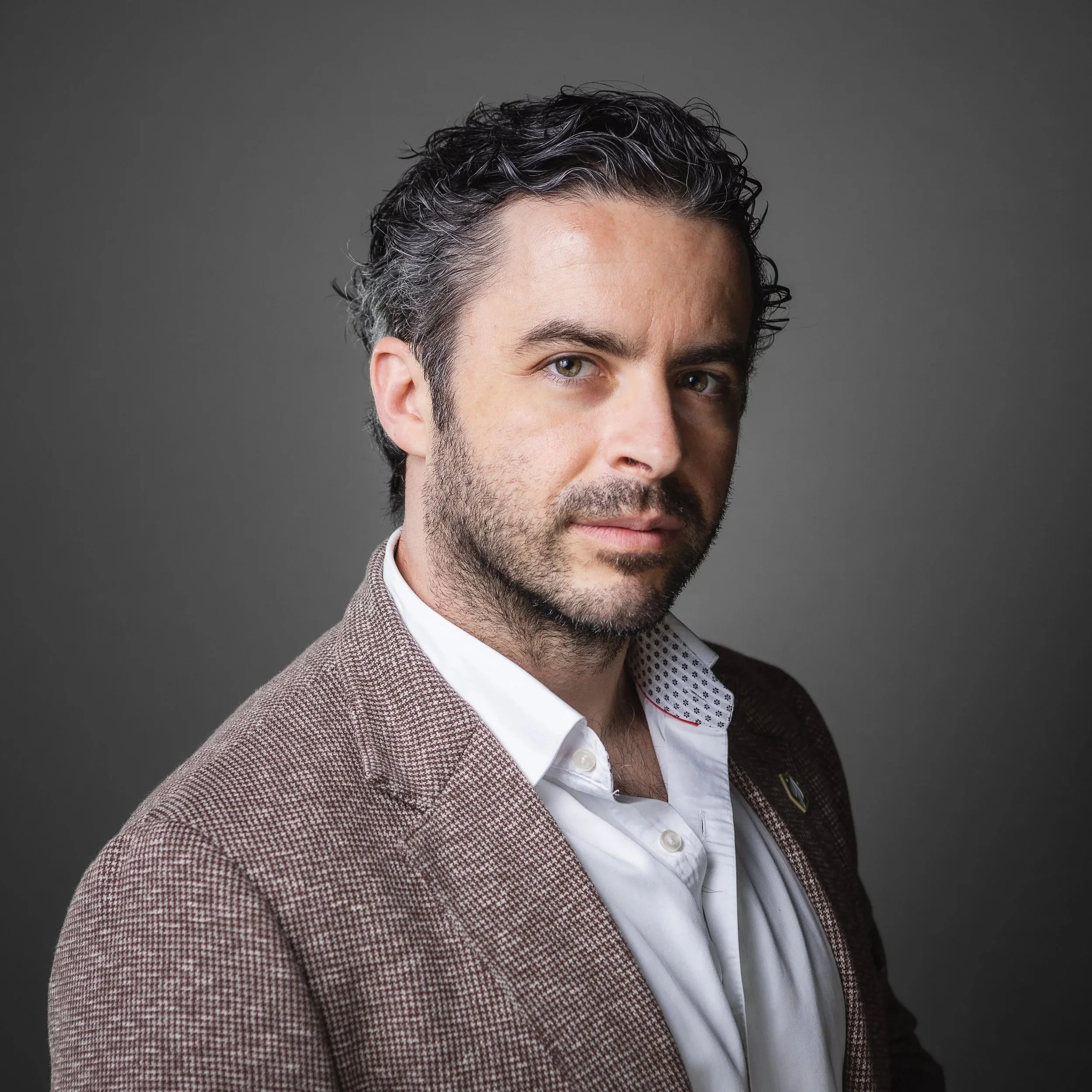
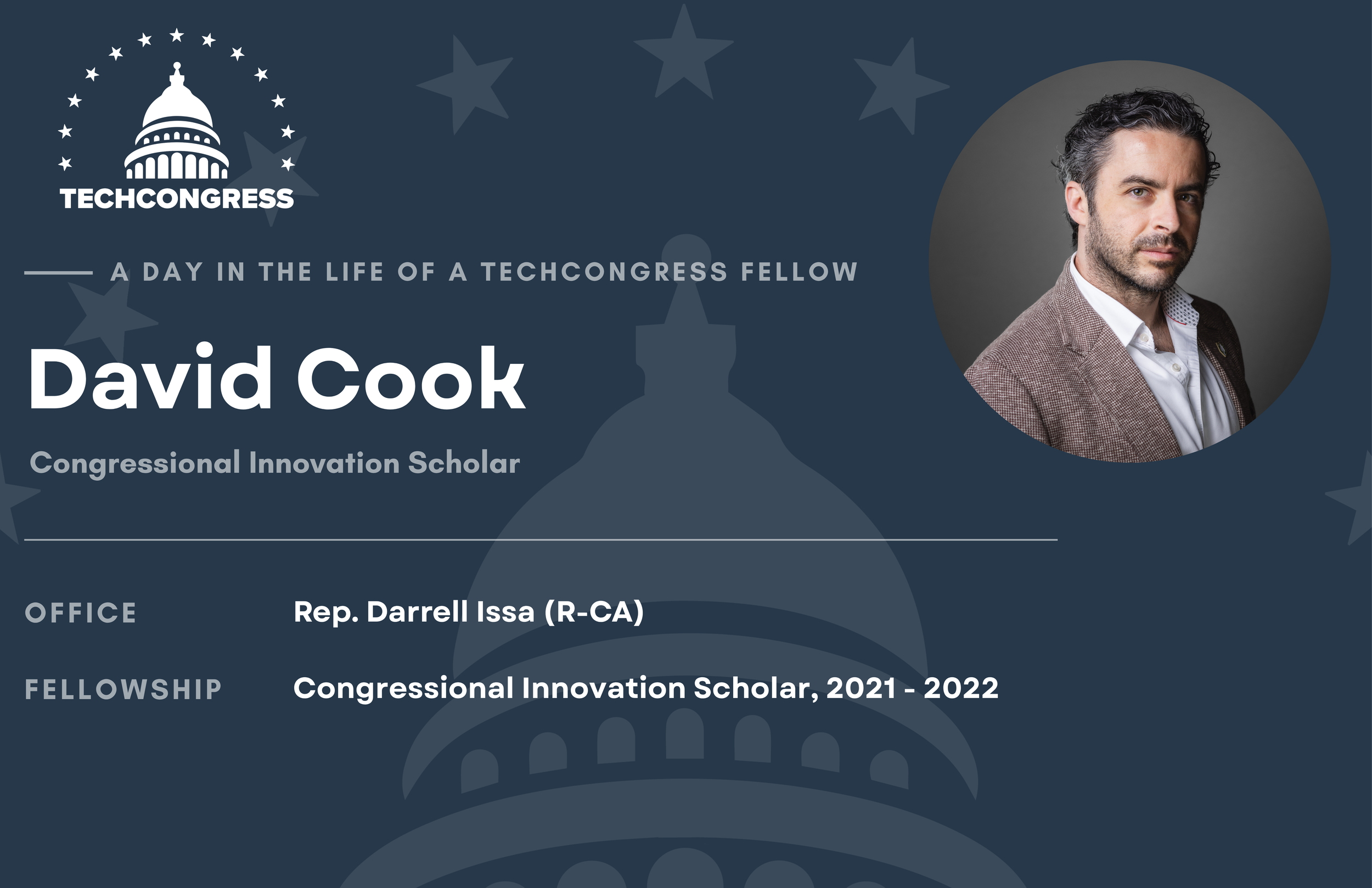
This piece was written by TechCongress alum, David Cook (Congressional Innovation Scholar, 2021).
David began his military career in the 82nd Airborne Division as a reconnaissance scout before being selected for Special Operations Forces Psychological Operations Regiment – where he gained first-hand knowledge and expertise in the dangerous implications of disinformation on populations and nations.
As a former service member, David is eager to serve his country in a different capacity while bringing his experience and expertise to implement technologically focused solutions to policy issues – especially those focused on National Security and Defense. He has a Master of Arts in Strategic Studies and a Bachelor of Arts in Strategic Studies and Defense Analysis from Norwich University.
David is serving with Rep. Darrell Issa (R-CA) and working on issues pertaining to AI, defense tech procurement, and data privacy.
LinkedIn: https://www.linkedin.com/in/david-n-cook/